Commercial and Large Loss Restoration Services

Prism manages large loss contents restoration through full inventory tracking, restorability reporting, and coordinated specialty response — helping stakeholders move claims forward from day one. When a commercial loss affects operations, response time matters. Claims are typically initiated by adjusters, contractors, consultants, or businesses managing operational disruption.

What Is Commercial and Large Loss Restoration?

Commercial and large loss restoration is the coordinated recovery of high-volume, multi-category equipment and contents across complex commercial insurance claim restoration scenarios. Unlike general providers or typical commercial disaster recovery services, Prism manages specialty contents and equipment at scale through division-specific workflows, centralized documentation, and claim-ready reporting.

This form of commercial contents restoration applies to commercial equipment, electronics, documents, textiles and art, and specialty contents impacted by fire, smoke, water, vandalism, or catastrophe events.

What Prism Restores on Commercial and Large Loss Claims

Prism Specialty Restoration restores a wide range of business-critical contents as part of large loss specialty restoration and catastrophe contents restoration projects.

  • Industrial machinery and equipment
  • Commercial HVAC components
  • Office electronics and IT systems
  • Server farms
  • Medical and laboratory equipment
  • Manufacturing tools and assets
  • Retail inventory and fixtures
  • Documents and business records
  • Textiles and uniforms
  • Specialty production equipment
  • Warehouse contents and storage items
  • Municipalities
  • Laboratories 
  • Schools and universities
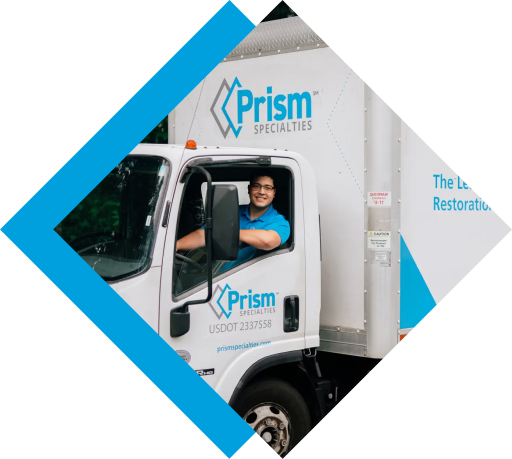
An employee smiles from the driver's seat of a Prism Specialties service truck.

How Prism Restores Commercial & Large Loss

Prism’s commercial contents restoration process is built to integrate with restoration contractors and support insurance claim requirements whether operating as a specialty subcontractor or coordinating directly with the claim team. Each step is structured, documented, and designed to maintain control from initial evaluation through restoration and return.

Step 1: Assessment & Inventory

Commercial contents are typically evaluated on-site. Prism documents affected items in place, capturing photo documentation and establishing a detailed inventory before any cleaning occurs. This creates a clear baseline for scope, handling, and claim visibility.

Step 2: Multi-Division Coordination

Contents are routed across electronics & equipment, textiles, and document divisions simultaneously. This coordinated approach allows complex, multi-category losses to be processed efficiently while maintaining centralized tracking and reporting.

Step 3: Restorability Determination

Each item receives a written restorability assessment. Non-restorable items are documented for adjuster review with condition notes and replacement references.

Step 4: Industry Leading Cleaning Standards

Items are restored to pre-loss condition using proprietary chemicals and cleaning processes. Commercial equipment and electronics are cleaned to the historical IPC J-STD-001 standard. Any items that cannot be returned to pre-loss condition are documented on a non-salvage report.

Step 5: Quality Control & Return

Restored items undergo final quality checks with a complete documentation package delivered prior to billing.

See our full pack out and documentation process

Pack-out Storage

Find out More

Prism technician with a hand truck at a loading dock

Specialty Restoration Techniques for Complex Commercial Equipment

Prism applies specialized cleaning and restoration processes — including dry ice blasting, ultrasonic cleaning, and steam cleaning — to efficiently remove post-loss contaminants from industrial and production equipment. Whether cleaning industrial manufacturing lines, food production equipment, control cabinets, conveyor belts, CNC machines, server racks, or restaurant equipment, each technique is selected based on equipment type and damage category. Prism has the proven processes and techniques to successfully return items to pre-loss condition.

Commercial & Large Loss Restoration for Insurance Claims

Prism operates as a specialized partner to commercial restoration firms and insurance claims support teams, aligning with the documentation and communication standards required to close complex losses.

Deliverables list:

  • Photo-documented inventory from pack out through restoration proposal
  • Written restorability assessment per item
  • Non-restorable inventory report
  • Industry leading cleaning standards
  • Progress communication at each restoration phase
  • Final documentation package delivered before billing

Prism works directly with adjusters, contractors, consultants, and commercial disaster recovery teams on large-scale losses, while also supporting businesses navigating operational recovery. Across completed restoration projects, Prism has historically documented an average 15% increase in work productivity upon completion, demonstrating how specialty restoration can help organizations recover functionality while minimizing disruption and replacement delays.

See examples of Prism's specialty restoration work

Need Specialty Contents Restoration Support?

Whether you’re managing a catastrophe event, coordinating a large loss specialty restoration, or supporting a complex commercial insurance claim restoration, Prism is structured to respond quickly. Submit a claim and a specialist will assess contents, document the loss, and coordinate the appropriate restoration divisions.

When Should Commercial Equipment and Contents Be Restored Instead of Replaced?

For adjusters managing large commercial losses, the restore-versus-replace decision is one of the most consequential calls on a claim. In many commercial contents restoration scenarios, restoration is the more practical, fastest, and cost-effective path — especially in large loss contents restoration where replacement timelines can delay operations.

Prism evaluates each item against these criteria before any work begins. Every decision is documented with item-level reporting, including condition, testing results, and a clear restore-versus-replace recommendation.

For large or complex losses, this evaluation happens across the full inventory allowing adjusters to make consistent, defensible decisions while businesses prioritize what needs to be returned to operation first.

Restoration is appropriate when:

  • The item can be returned to pre-loss function through controlled restoration and testing
  • Restoration turnaround is faster than sourcing and installing a replacement
  • Replacement involves long lead times, backorders, or operational disruption
  • The cost to restore is meaningfully lower than full replacement

Replacement is appropriate when:

  • The item cannot be restored to safe or reliable working condition
  • Damage has compromised core components beyond repair
  • Restoration cost approaches or exceeds replacement cost
  • Compliance, safety, or manufacturer standards require replacement

Frequently Asked Questions

Commercial and large loss restoration is the coordinated evaluation, recovery, and documentation of high-volume contents across complex commercial insurance claim restoration scenarios. It includes inventory tracking, restorability analysis, and multi-division workflows to support accurate claim resolution. This approach is essential in large loss contents restoration, where scale and documentation requirements are significantly higher.

Restoration Insights & Resources

Industry News

Updates, media coverage, and industry insights related to specialty contents restoration.

In the News

Case Studies

Examples of how Prism supports adjusters, contractors, consultants, and businesses across complex loss events.

Case Studies

Restoration Insights

Articles covering documentation, restoration workflows, and post-loss best practices.

Blog
Secret Link